
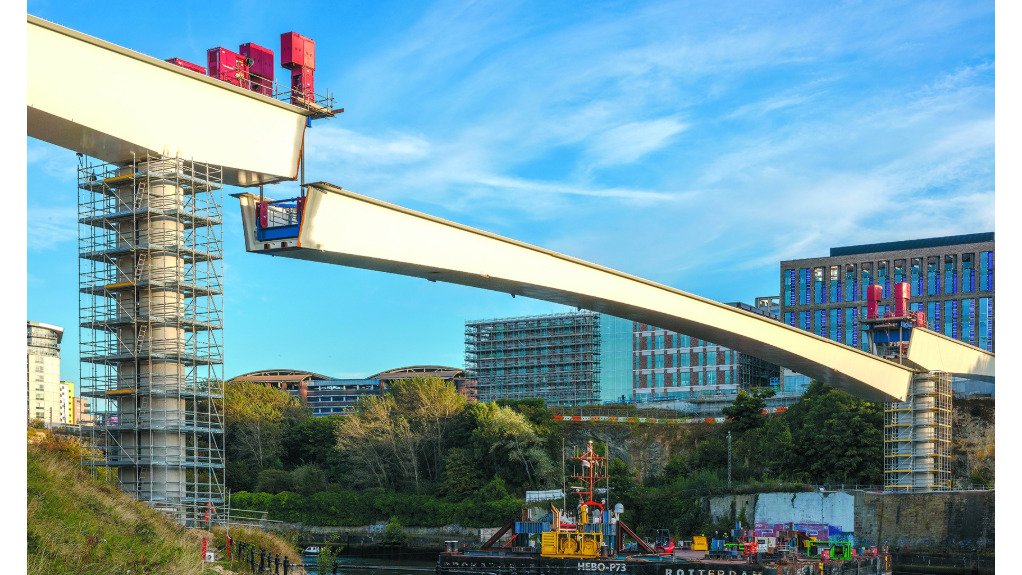
Heavy lifting and transportation specialist Mammoet has successfully completed the delivery and installation of all four steel sections of the New Wear Footbridge, a project led by the Sunderland City Council in England. The bridge will play a vital role in the Riverside Sunderland project, connecting pedestrians and cyclists from the city center to the Stadium of Light, home to Sunderland Association Football Club.
The installation posed significant challenges, particularly as it took place in a busy urban environment. To simplify the overall schedule, the bridge was constructed in as few modules as possible. As an expert in efficient bridge installations, Mammoet was responsible for managing the smooth delivery and heavy lifting of the sections.
The 250-meter-long steel-concrete composite bridge, fabricated by Victor Buyck Steel Construction in Ghent, Belgium, weighs approximately 1,150 tons and consists of four sections. These sections were shipped in two separate voyages spaced a month apart. This "Just-in-Time" approach allowed Mammoet to install the first two sections while preparing for the arrival of the remaining two.
The operation began on the north side of the river, where the first two sections were lifted from a barge and placed onto concrete plinths near the water's edge using an LR 11350 crawler crane. Once these sections were in place, the crane was dismantled and relocated to the south side to receive and install the final two sections.
The largest section, measuring 105 meters and significantly heavier than the others, required the use of strand jacks to lift it into place, as the crawler crane lacked the capacity for such a heavy lift. This method avoided the need to split the bridge into five sections, which would have extended the project timeline.
The project encountered several logistical and operational challenges. Precise scheduling was essential to coordinate the transport of the crawler crane components, which were delivered from the Port of Nigg in Scotland using 50 trailers. Each component needed to arrive in the correct sequence to allow for efficient assembly. Mammoet maintained open communication with the client, sharing detailed transport schedules to avoid delays.
Restrictions on waterway access due to changing water levels also required careful planning. Although barges could be positioned in the middle of the river, opportunities to move them closer to the edge were limited. The curved underside of the bridge sections added another layer of complexity, as their geometry caused one end to sit higher when placed on conventional trailers. This required careful jacking to level the sections during transport and installation.
Space constraints on the south side of the river further complicated the project. To address this, Mammoet used the Port of Sunderland as a temporary storage area for dismantled crane components, transporting the boom sections there first before eventually dismantling the main crane structure.
Through strategic planning and innovative solutions, Mammoet ensured the project remained on schedule while overcoming logistical, spatial, and technical challenges. The company's early involvement in the project allowed for efficient site management, ensuring a safe and smooth operation.
"This project highlights how Mammoet's expertise in heavy lifting and smart site management can help clients navigate even the most complex challenges," said project manager Richard Gatenby.
The New Wear Footbridge will soon serve as a key connection for Sunderland, supporting the city's growth and showcasing cutting-edge engineering solutions.
The installation posed significant challenges, particularly as it took place in a busy urban environment. To simplify the overall schedule, the bridge was constructed in as few modules as possible. As an expert in efficient bridge installations, Mammoet was responsible for managing the smooth delivery and heavy lifting of the sections.
The 250-meter-long steel-concrete composite bridge, fabricated by Victor Buyck Steel Construction in Ghent, Belgium, weighs approximately 1,150 tons and consists of four sections. These sections were shipped in two separate voyages spaced a month apart. This "Just-in-Time" approach allowed Mammoet to install the first two sections while preparing for the arrival of the remaining two.
The operation began on the north side of the river, where the first two sections were lifted from a barge and placed onto concrete plinths near the water's edge using an LR 11350 crawler crane. Once these sections were in place, the crane was dismantled and relocated to the south side to receive and install the final two sections.
The largest section, measuring 105 meters and significantly heavier than the others, required the use of strand jacks to lift it into place, as the crawler crane lacked the capacity for such a heavy lift. This method avoided the need to split the bridge into five sections, which would have extended the project timeline.
The project encountered several logistical and operational challenges. Precise scheduling was essential to coordinate the transport of the crawler crane components, which were delivered from the Port of Nigg in Scotland using 50 trailers. Each component needed to arrive in the correct sequence to allow for efficient assembly. Mammoet maintained open communication with the client, sharing detailed transport schedules to avoid delays.
Restrictions on waterway access due to changing water levels also required careful planning. Although barges could be positioned in the middle of the river, opportunities to move them closer to the edge were limited. The curved underside of the bridge sections added another layer of complexity, as their geometry caused one end to sit higher when placed on conventional trailers. This required careful jacking to level the sections during transport and installation.
Space constraints on the south side of the river further complicated the project. To address this, Mammoet used the Port of Sunderland as a temporary storage area for dismantled crane components, transporting the boom sections there first before eventually dismantling the main crane structure.
Through strategic planning and innovative solutions, Mammoet ensured the project remained on schedule while overcoming logistical, spatial, and technical challenges. The company's early involvement in the project allowed for efficient site management, ensuring a safe and smooth operation.
"This project highlights how Mammoet's expertise in heavy lifting and smart site management can help clients navigate even the most complex challenges," said project manager Richard Gatenby.
The New Wear Footbridge will soon serve as a key connection for Sunderland, supporting the city's growth and showcasing cutting-edge engineering solutions.
About this article
From the Medical Directory library. For advice about your own health, speak to your healthcare professional.
JOIN THE CONVERSATION



No comments yet. Add a thoughtful question or comment about this article.